 EN
 Deutsch
 Français
 Italiano
 Español
 Português
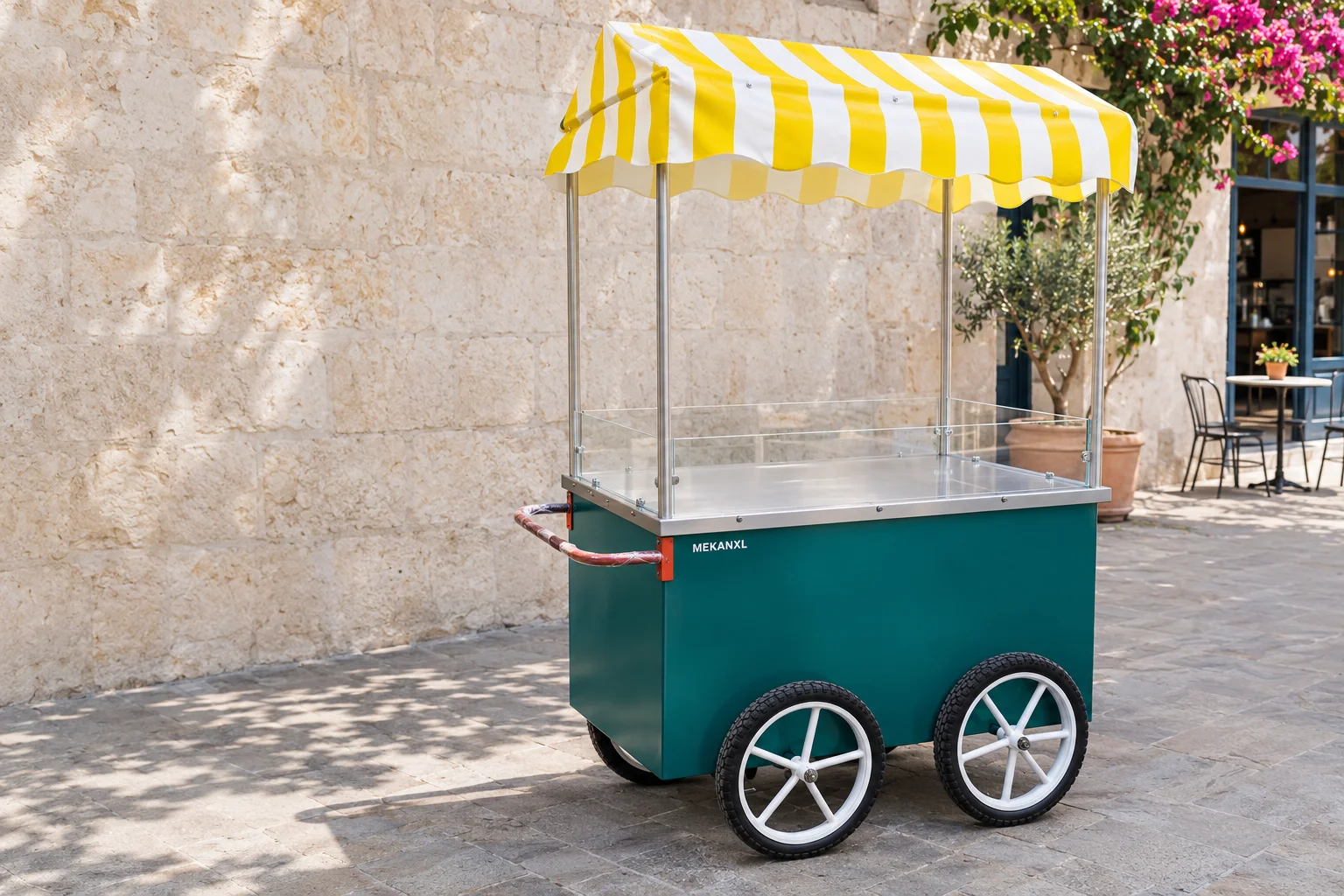
What you pay, item by item
| Cost item | Amount | Notes |
|---|---|---|
| Cart | €429 to €1,209 net | Fixed per size, logo printing included |
| Transport | Quoted per delivery address | Depends on country, postcode and quantity |
| Customs duty | Generally 0% | With an A.TR movement certificate |
| Customs clearance | Quoted, or charged by your broker | Fee for the customs declaration |
| Import VAT | Your country's VAT rate | Normally deductible for VAT-registered businesses |
Why there is usually no customs duty
The EU and Türkiye have formed a customs union since 1996. It covers industrial goods: goods made in Türkiye or in free circulation there can enter the EU without customs duty. The proof is an A.TR movement certificate that travels with the shipment. Since 2024, EU customs also accept A.TR certificates issued electronically.
A vending cart is an industrial product, so this applies to it. Two things are worth knowing. Agricultural products and basic coal and steel products fall outside the customs union and follow separate rules; a finished cart is not one of them. And in rare cases special duties, such as anti-dumping duties, apply to specific products. Your customs broker checks both against the tariff number.
Without an A.TR, customs can charge the normal duty for goods from outside the EU. Make sure it is in the shipping documents.
Import VAT: you pay it first and normally get it back
Import VAT is charged by customs in the country where the cart enters free circulation, usually the country you live in. It is calculated on the customs value of the goods, which includes transport and insurance up to the EU border, plus any duty and the costs of getting the goods to their first destination in your country. In practice that means the cart price and most of the transport cost.
If your business is VAT-registered and uses the cart for taxable sales, you can normally deduct the import VAT as input tax in your next VAT return. It then costs you cash flow for a few weeks. Some countries let registered businesses declare import VAT in the VAT return instead of paying it at the border.
If you use a small-business VAT exemption, you usually cannot reclaim it. In that case import VAT is a real cost and belongs in your budget.
Worked example: one 60 × 120 cm cart
The cart costs €699 net. Customs duty is 0% with an A.TR. Transport and clearance are quoted for your address, so we leave them as placeholders. The table shows the import VAT on the cart price alone; add the same rate on the transport cost.
| Country | Standard VAT rate | Import VAT on the cart | Plus |
|---|---|---|---|
| Germany | 19% | €132.81 | 19% of transport |
| France | 20% | €139.80 | 20% of transport |
| Italy | 22% | €153.78 | 22% of transport |
| Spain | 21% | €146.79 | 21% of transport |
| Portugal | 23% | €160.77 | 23% of transport |
For Germany, the sum is: €699 for the cart, plus transport (quoted), plus clearance (quoted), plus €132.81 import VAT on the cart and 19% on the transport. If you are VAT-registered, you get the VAT back through your return, and your net cost is the cart, the transport and the clearance.
DAP or DDP: who deals with customs?
These are Incoterms, standard terms that say where the seller's job ends.
DAP (Delivered at Place): we organise transport to your address. You, or a customs broker you appoint, clear the cart through customs and pay the import VAT and any duty. Carriers often offer clearance for a fee.
DDP (Delivered Duty Paid): we also handle the customs clearance and pay the import charges, and the price you pay includes them. We offer DDP by agreement. Ask how the import VAT will appear on the paperwork, because that affects whether and how you can reclaim it.
Payment works the same way in both cases: 50% with the order and 50% after customs clearance, before delivery.
Checklist before you order
- Your business usually needs an EORI number to import. You apply for it at your customs authority.
- Have your VAT number ready, and know whether you can deduct input VAT.
- Decide on DAP or DDP and say so in your request.
- Give us the full delivery address and any access limits, such as no lorry access or no forklift.
- Check that the A.TR is part of the shipping documents.
This guide is general information, not tax or customs advice. Rules and rates can change. For your own case, ask your tax adviser or customs broker.